

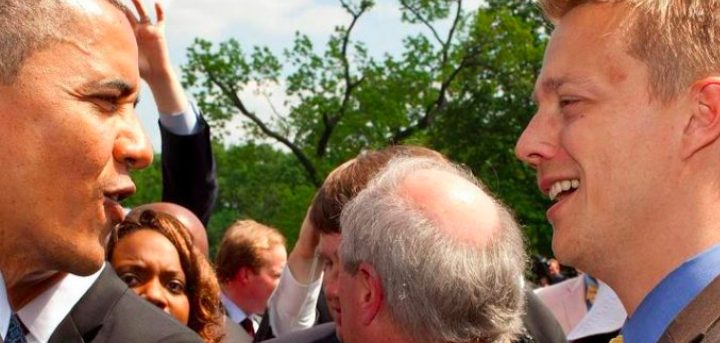
 Stratégies d’influence avec Tom Cochran, ex Digital Leader du Président Obama
Lors du IMedia Brand Summit organisé par Comexposium qui aura lieu le 13 et 14 juin à Biarritz, mydigitalweek a pu s’entretenir avec Tom Cochran, ex Digital Leader du Président Obama, invité d’exception à cet événement.
Une occasion unique pour comprendre : comment le premier « Digital President » de l’histoire a-t-il échangé directement avec ses électeurs ? Pourquoi s’est-il immédiatement positionné sur la transparence, la confiance et la collaboration dans sa relation avec le peuple américain ? Quelle place ont tenu les réseaux sociaux dans sa campagne ? Quelles sont les stratégies d’influence les plus efficaces en matière politique? Les réseaux sociaux sont-ils incontournables ? Réponses
My Digital Week : How did the first « Digital President » in History directly interact with his electors?
TOM COCHRAN : Franklin D. Roosevelt was the radio president. John F. Kennedy was the television president. And, Barack Obama was the digital president. What’s interesting to note is that each earned that label between 10 and 15 years after the technology became available to the White House. The first radio address was Calvin Coolidge in 1923, the first presidential speech on television was in 1947 by Harry S. Truman, and the first White House website was 1994 under Bill Clinton.
The difference between radio, television, and the internet is that the first two are unidirectional communication channels. The president speaks to Americans.
Under Obama, in September 2011, we launched We the People, powered by Drupal and open source technology, to open up the White House and provide a platform for anyone to ‘petition the government for a redress of their grievances’ a right enumerated in the First Amendment of the U.S. Constitution. Without the vision and leadership of Macon Phillips and a great team of dedicated digital practitioners, this would never have been possible. It was truly the first time that the people had direct line to the President and there was an unfiltered communication channel back for official administration responses to public questions and concerns.
In addition, people forget that when Obama came into office, the digital team pushed to modernize WhiteHouse.gov and leverage it as a platform to engage regularly with Americans, making sure communications were frequent and transparent. All press briefings were live streamed and available afterwards on demand. All press releases and blog posts were put up on the site to keep a constant flow of communications with the public.
2- Why did he immediately position himself on transparency, trust and collaboration in his relationship with the American People?
This move for transparency was in direct response to the opaque nature in which the prior administration operated. The scale and scope of government makes transparency difficult, but government leaders must, to the best of their abilities, push to operate in the open. This is why on his first full day in office, President Obama signed the “Transparency and Open Government” memo focusing on the three key characteristics of an open government: transparency, participation, and collaboration. Transparency was a fundamental component of how Obama and the administration governed, demonstrating that the government is here to serve the people and it is incumbent upon them to do so in an open manner.
3- What place did social networks/media hold in his campaigns?
A good friend once told me that you know you’re doing something important when other people take credit for your work. First, let me say that I was not on either campaign … I worked at the White House from 2011 to 2012 during the first term and at the U.S. Department of State from 2014 to 2016 during the second term.
I think it’s abundantly clear that the Obama campaign dominated both the social and digital space in the 2008 and 2012 campaigns. As an early high-profile adopter of social media, the campaign’s effectiveness was amplified by the millions of people galvanized around their candidate and the issues he supported. The network effect of having this massive base of supporters, all connected to each other, allowed messages to not only be broadcast, but multicast. Instead of a message coming from the campaign to individuals, it could now reverberate throughout “the nodes of the network” to spread ideas far and wide.
4- What are the most efficient influencing strategy in terms of politics? Are social networks a must?
It would be inappropriate for me to claim knowledge of superior influencing strategies in terms of politics. Social networks are certainly critical in spreading a message, but as we have witnessed over the recent national elections globally, “fake news” spreads rapidly and is given credence through the power of social networks. Thus, my opinion of social networks on the campaign is via observations and conversations with friends from the campaign.
These digital networks amplify the best and worst of humanity, accelerating the distribution of information for good and evil. Technology companies like Facebook, Google, and Twitter have a moral obligation to identify methods to mitigate this problem on a global scale, but more importantly, the individual must accept responsibility to become a more informed member of society.
5- What are the trends that are emerging at the moment? Do you have any advice to give to organizations?
In government, we are seeing further movement to the cloud and open source technology. This is a big step in the right direction, even though it’s 5-10 years behind what the private sector is doing.
We are also seeing the beginning of more immersive digital experiences beginning with 360 videos, virtual reality and augmented reality. This is the beginning of convergence between the real world and the digital world, overlaying contextual data to enhance an immersive experience.
Imagine having an augmented reality data layer appear in front of you during a business meeting. Appearing over the heads of attendees could be LinkedIn profile data, Tweets, or other contextual information about meeting attendees. Of course the Internet of Things is exploding with an expected 50 billion devices connected to the Internet by the end of this decade. That’s more than 7 devices per human on this planet.
6- What message would you like to share/send?
In an age of “fake news” I strongly believe in the resurgence in respected media outlets. In the U.S. we have great institutions like the New York Times, The Atlantic, and the Washington Post. They have excellent reputations build up over generations for fact-driven, evidence-based journalism. This is more important now than it has ever been.
It was incredibly interesting to see the difference in how the U.S. media responded to “fake news” and hacking disclosures during our election and how the French media responded to similar circumstances. Maybe a lesson was learned by watching the negative consequences in the U.S., thus the French media showed more restraint giving visibility to fake news stories.
Annie Abela Lichtner
Journaliste
Pour en s’inscrire sur IMEDIA Brand SuMMIT 2017 cliquer ici